
Beyond Academia: The Power of Writing Retreats
by Dr. Rebecca Maxwell Stuart
Recently, I was invited to write an article for the British Educational Research Association’s (BERA) Research Intelligence magazine (Spring 2026 special edition on cultivating quality in higher education) that highlighted how structured writing retreats can enhance research quality.
Within the article, I describe writing retreats as intentional interventions that enhance individual productivity while also contributing to a wider culture of sustainable research excellence within higher education. By creating the conditions for focus, reflection and momentum, writing retreats can play a powerful role in nurturing both people and their work.
A Moment That Captured It All
I would like to share a beautiful moment of alignment when I received the proof copy of the article whilst facilitating a small, nourishing Acorn Writing Retreat at the beginning of January 2026. During the retreat, there were several discussions regarding the power and potential of trees. One of the academic writers shared that just before leaving home for the retreat, her young daughter had slipped a little pine cone into her pocket for good luck. It was a lovely surprise to then discover that the picture chosen for the article was of a small sprouting oak tree with a pine cone in the foreground (see below).
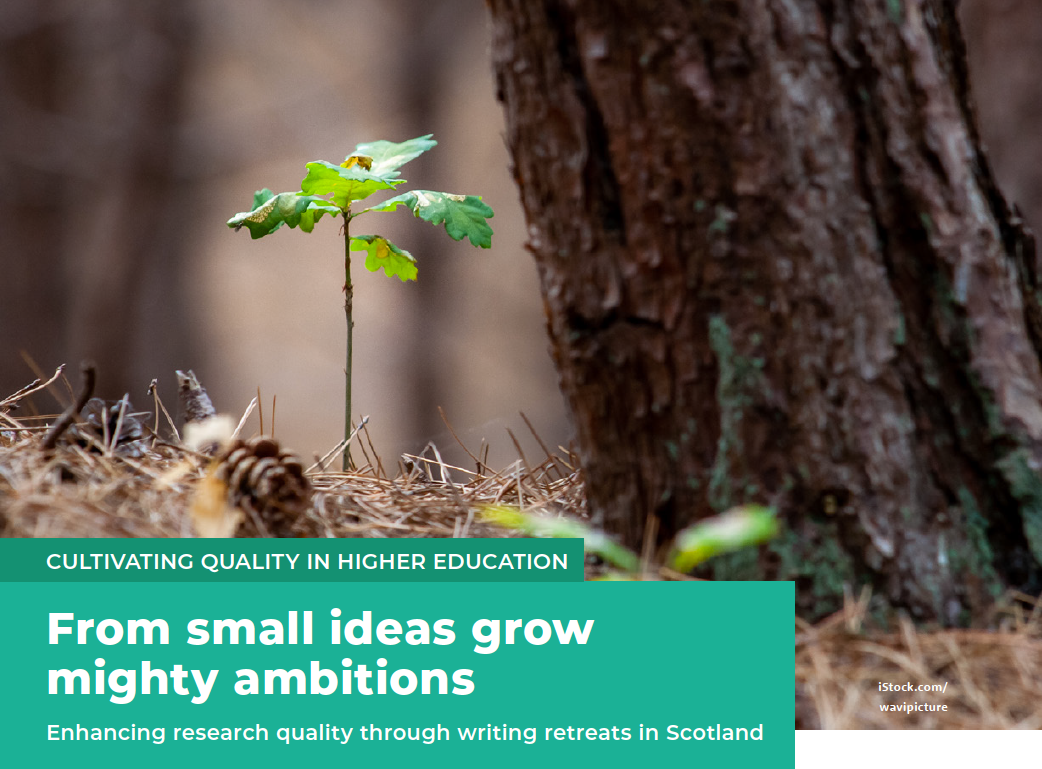
A moment of alignment: the picture used for my article in Research Intelligence of a small oak and a pine cone. Source: Research Intelligence (Spring 2026) published by BERA.
There were many reasons that I chose the name “Acorn Writing Retreats” (a future writing project for sure!) but a key reason was that many writers can relate to the transformative journey of a tiny acorn into a magnificent oak tree. Often writing projects (academic and non-academic) begin with a brief notion that lingers. With the right structure and nurturing conditions, these small ideas grow into mighty ambitions (just like our motto).
Not Just Academic Writing
While the Research Intelligence article concentrates on the benefits of structured writing retreats for academics (see also Murray & Newton, 2009), I have found that these aspects also support authors (both aspiring and published), poets, business owners and others who are in need of dedicated time, space and community to progress their writing.
Quite often, I receive emails from non-academic writers wondering if our retreats are “for them”. It is always a joy to reassure them and even more so to witness how they settle in and begin to blossom within the nurturing environment.
Where Writing Finds Space to Grow
At Acorn Writing Retreats, the supportive community at each retreat is diverse and inclusive. Many writers (both academic and non-academic) explain how they value the different perspectives in the room and the opportunity to glimpse the wide range of projects being developed.
This interdisciplinary mix creates an energising and inspiring atmosphere where ideas cross-pollinate, confidence grows and writers feel both held and inspired in their work.
In the Research Intelligence article, I reflect that, “ultimately, when we nurture researchers, we nurture quality” (Maxwell Stuart, 2026, p.27). Here, I would like to extend this further: when we nurture writers, we nurture quality by boosting their confidence, reigniting their passion for writing and helping their ideas grow into mighty ambitions.
So if you are in need of a space where small ideas are given the time and care to grow into something of significance, Acorn Writing Retreats could be your answer.
Maxwell Stuart, R. (2026) From small ideas grow mighty ambitions: Enhancing research quality through writing retreats in Scotland, Research Intelligence (Spring 2026), British Educational Research Association, pp. 26-27. Available at: https://www.bera.ac.uk/publication/spring-2026
Murray, R. & Newton, M. (2009) Writing retreat as structured intervention: margin or mainstream? Higher Education Research & Development, 28(5), pp. 541-553. Available at:
https://narti.org.uk/wp-content/uploads/sites/52/2020/12/Murray_and_Newton_2009.pdf